1 min read
Do I Need CMMC?
You need CMMC if your organization handles Federal Contract Information (FCI) or Controlled Unclassified Information (CUI) under a Department of...
3 min read
Real Compliance
:
Updated on September 11, 2026
Whether your product is a machined part, clean water, or electricity on a wire, your operations depend on equipment your security program probably does not cover.
Continuity planning is generally built around information (servers, endpoints, email, file shares) while the systems doing the physical work go unwatched. This is not usually by decision, but by habit, and this is why operational technology represents real business risk.
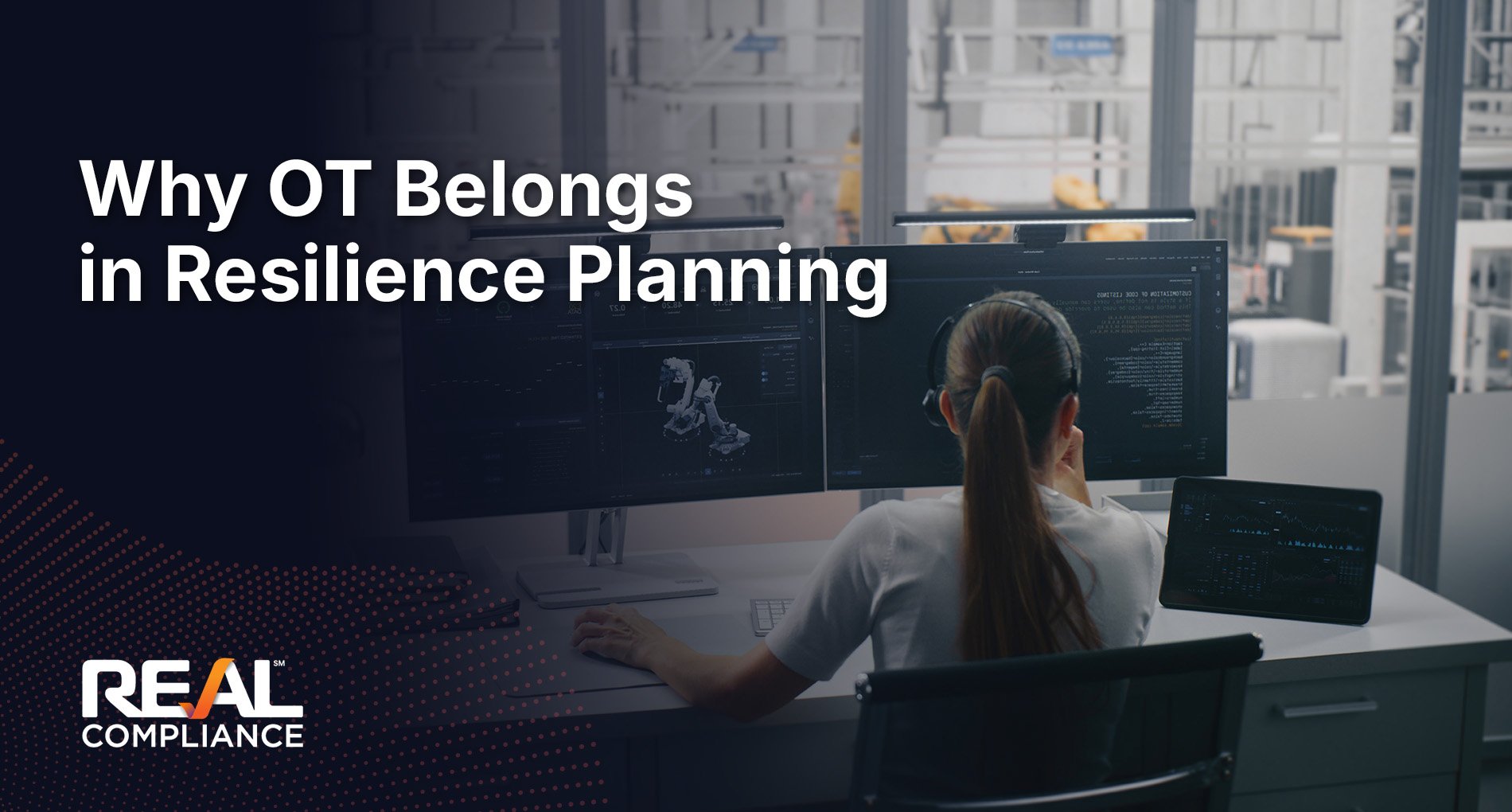
Operational Technology, often referred to as "OT", includes the machines, sensors, controllers, and physical systems that are found throughout manufacturing facilities.
Some of the more familiar components are:
PLCs - programmable logic controllers, the small industrial computers running a machine's logic
SCADA and HMI - supervisory control systems and the touchscreen panels operators use
CNC machine controls - the Fanuc, Siemens, or Haas controller on a mill or lathe
Sensors and actuators - the IIoT layer feeding data up and commands down
Building systems - HVAC, badge readers, cameras, fire suppression, elevators
There is a perception that OT components are low risk; however, there is historical data to suggest otherwise.
The 2010 Stuxnet worm remains a classic proof of OT risk. The worm crossed an air gap on a USB drive, rewrote the logic on Siemens PLCs, and tore apart uranium enrichment centrifuges at Natanz, Iran. As the attack unfolded, normal sensor data was replayed to operators, concealing the destruction.
In 2013, attackers breached Target through an HVAC contractor, stealing the remote-monitoring credentials used to service store climate systems. The attack pivoted from that building-systems foothold into the retailer's payment environment, exposing 40 million debit and credit card accounts.
In July 2026, coordinated attacks on internet-exposed PLCs disrupted water systems across at least a dozen states, disabling controls in more than 30 Minnesota communities alone.
Physical OT components are often the easiest way in. These are the badge readers, cameras, HVAC controllers, and building automation systems that share networks with production equipment. It is not uncommon to find that these are some of the oldest, least maintained, and least owned devices in the building, making them easy targets for bad actors.
Another plausible scenario involves the physical aspect of OT security. Imagine an unescorted visitor at a manufacturing facility plugs a thumb drive into an open slot on an unattended machine and leaves unnoticed. Not long after, major failures bring the shop floor to a halt. The root cause investigation will be as arduous as finding a needle in a haystack.
These are more common than we'd like to think.
The most consistent finding in OT security is not that defenses are weak, but that visibility is absent. Dragos, in its annual OT Cybersecurity Review, reports that only about "30% of OT networks have adequate visibility," and "56% of organizations cannot see below the IT/OT boundary."
Roughly 3,300 industrial organizations were hit by ransomware in the last reporting year, and Dragos is currently tracking 26 active OT threat groups.
Most organizations learn they have a problem only when a process begins to behave strangely, or machine run-rates miss their targets enough times to create a trend. By then, the response window has closed. This is why OT monitoring belongs in the security program rather than in a future budget cycle.
An accurate asset inventory, passive network visibility into OT, and a sufficient alert response are the difference between a contained incident and a major shutdown.
One primary reason to bring OT into scope is that the loss is measurable and significant. A data breach costs you remediation, reputation, and in some cases, a loss of contracts. The financial impact of an OT event includes production time, material costs in scrap/rework, and missed revenue per hour.
Including OT in your security and continuity planning is not a box-checking exercise. It is the recognition that the machines your business runs on are as important as the data describing them.
The cost of inclusion is often not nearly as expensive as the cost of an incident.
One of our partners, MNS Group, is affiliated with Dragos, enabling purpose-built OT asset visibility, threat detection, and response capability to environments where traditional IT providers cannot.
If cost is a barrier, begin small and scale over time. Contact our team for recommendations on how to map your boundary, and let's build a realistic plan to close security gaps.
1 min read
You need CMMC if your organization handles Federal Contract Information (FCI) or Controlled Unclassified Information (CUI) under a Department of...
1 min read
This article is a repost from MNS Group, a Real Compliance™ partner. Click here to read the original article. When it comes to choosing...
1 min read
For many defense contractors, the Cybersecurity Maturity Model Certification (CMMC) feels like a looming storm cloud. Rumors of astronomical costs,...